How much it really costs to renovate a Tuscan farmhouse
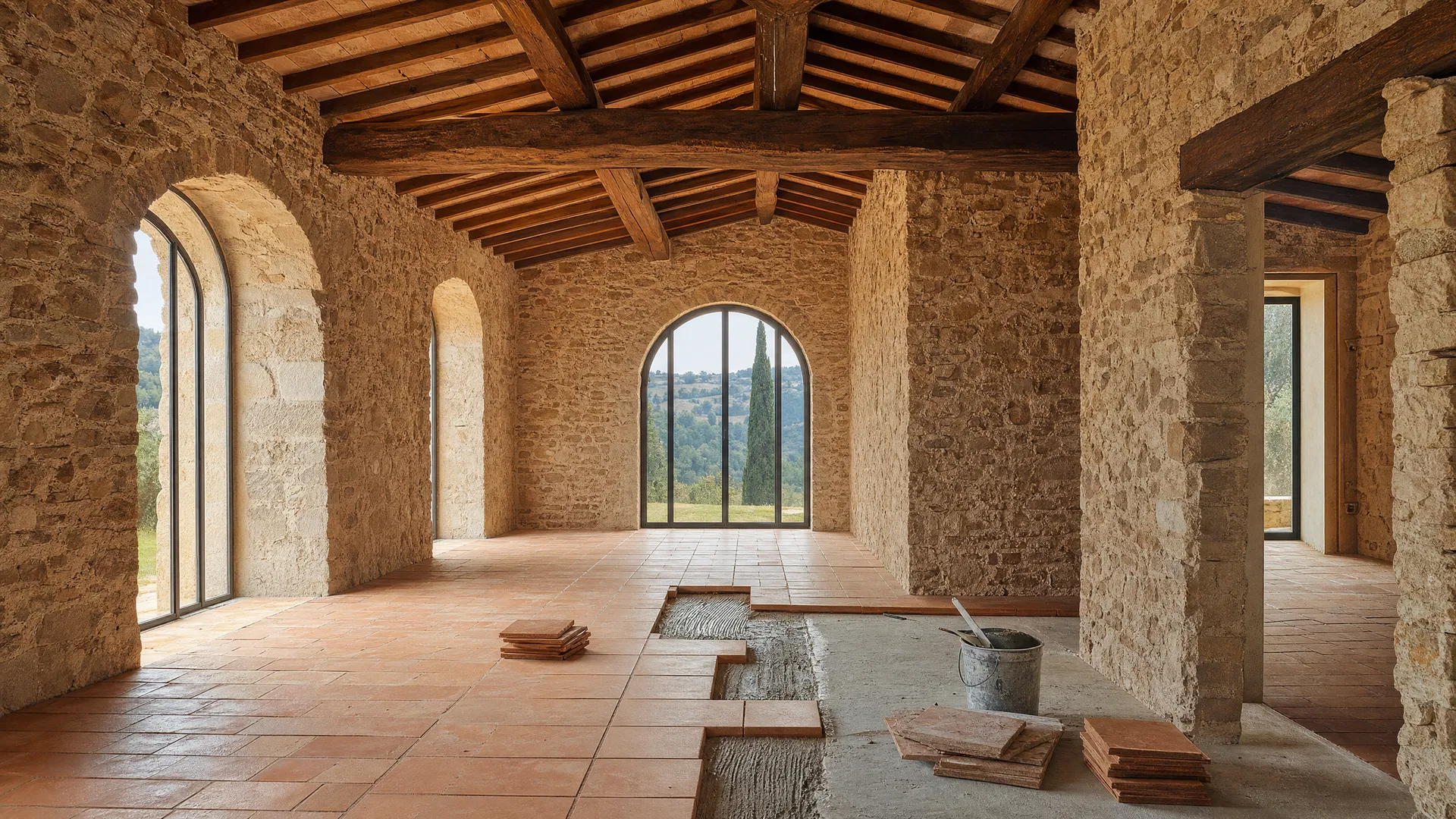
How much does it cost to renovate a Tuscan farmhouse? It is the question we are asked most often, and also the one it is most dangerous to answer with a single figure. A price per square metre taken from a generic article describes a sixteenth-century stone farmhouse no better than a price list describes a tailor. And yet it is precisely on that single figure that many buyers build their budget — only to watch it collapse on site.
This article will not give you a magic number. It will give you the correct way to think about the cost of renovating a farmhouse in Tuscany, with indicative market ranges, the items that blow the budget, and the questions to ask before signing a purchase with the wrong estimate in your head.
Why "price per square metre" is misleading
The cost of a high-end renovation depends on variables the square metre cannot see: the structural condition of the walls and roof, the presence or absence of services, the desired level of finish, site accessibility, and the restrictions that impose specific materials and techniques. Two farmhouses of the same size, a few kilometres apart, can carry very different intervention costs.
The square metre measures surface area, not complexity. And in a farmhouse, the cost lies almost entirely in the complexity.
Indicative cost ranges for a Tuscan farmhouse
While stressing that every property is a case of its own, it helps to have orders of magnitude so you do not start with unrealistic expectations. These are the ranges we encounter most often on the 2024-2026 market.
Costs should be estimated for the individual building after assessing its starting condition and defining the works. The estimate should specify its date, assumptions, inclusions and exclusions.
The figures are indicative and do not replace a technical estimate on the individual property. They exclude furnishing, high-end landscaping and extraordinary permit costs.
The items that blow the budget
In our experience, overruns almost always come from the same areas, rarely estimated with care at the purchase stage.
| Area of work | Why it weighs | When it emerges |
|---|---|---|
| Structural consolidation | Walls, foundations, floor structures and historic arches | After the first inspections on site |
| Roofing | Roof rebuild, insulation, recovery of original tiles | Often only after stripping back |
| Services | Electrical, plumbing, heating, home automation from scratch | At the detailed design stage |
| External works | Access, ground, water management, garden | Almost always underestimated |
| Restrictions and materials | Techniques and materials imposed by heritage protection | At the permit stage |
The hidden costs nobody budgets for
The contingency allowance should reflect the uncertainties of the individual property, alongside professional fees, permissions, connections and external works. A generic percentage does not guarantee an adequate budget.
The difference between a quote and the real cost
A quote is a promise made on partial information. The real cost is what you discover when the walls come down. The distance between the two depends on the quality of the design and the surveys carried out before starting. A good process does not eliminate surprises, but it reduces them drastically and anticipates them, while there is still time to decide.
This is why, at MANINI, the cost estimate is not an Excel sheet delivered from a distance: it comes from a technical survey, from reading the documents and from an assessment of the property's real condition. It is an integral part of due diligence, not a separate exercise. It is the same rigour with which we judge whether a property deserves the MANINI Approved seal.
What to ask before signing
Before the preliminary contract, a buyer should have a documented answer to these questions:
- What is the real structural condition, verified rather than declared?
- Which works are mandatory and which are matters of taste?
- Which techniques or materials are imposed by the restrictions?
- What is the realistic cost range, with a contingency margin?
- How much does the build affect the timeline, and the timeline the cost?
This kind of verification is particularly delicate in high-protection areas such as the Val d'Orcia or the Argentario, where restrictions directly affect the materials and techniques permitted.
Frequently asked questions about farmhouse renovation costs
Purchase price and works depend on location, condition, records, access and scope. Relevant comparisons and a case-specific estimate are needed; neither savings nor future value can be guaranteed.
Is it better to buy an already renovated farmhouse or one to renovate? It depends on the gap between purchase price and intervention cost, and on the quality of the existing renovation. A well-renovated farmhouse with compliant documents can be more cost-effective than a "cheap" ruin that hides an unpredictable building site.
The contingency allowance should reflect the uncertainties of the individual property, alongside professional fees, permissions, connections and external works. A generic percentage does not guarantee an adequate budget.
Are permit costs significant in a protected area? They can be, both in money and in time. In landscape and UNESCO areas the process must always be budgeted for, because authorisation times affect the build timeline and therefore the overall cost.
The bottom line
The cost of a renovation is not a number to look up online: it is the result of a technical analysis on the individual property. Anyone who promises you a precise figure before seeing the walls is not protecting you — they are selling to you. The right figure is the one that comes after the verification, not before.
If you are considering buying a farmhouse and want to understand the real cost of the operation before exposing yourself, talk to us: we put the cost estimate inside the due diligence, not after the signature.
Considering a purchase in Tuscany?
Let's talk before you sign anything. The first analysis is a conversation, not a quote.
Talk to us